Proton–Electron Cosmology
Abstract
On a given 3D Euclidean space (Many-Minds Relativity), two co-aligned fluctuating potentials — gravitational and electric — seed the universe at small scale. Mass and charge are not assumed: they are read off as the curvature of the potentials (ρ = ∇²φ), so both come in variable sign and sum to zero (no net mass, no net charge), with small scales amplified by the Laplacian — the seed itself a small fluctuation. From this one seed the universe develops in two tiers: large-scale gravitation — positive mass aggregating into the cosmic web, negative mass repelling as dark energy — and small-scale electromagnetics — the co-seeded ±charge, with + tied to the large mass (protons) and − to the small (electrons), forming nuclei and atoms. As gravitational contraction makes the positive mass hot and dense, deuterons and nuclei form (~MeV, RealNucleus) — the step required for everything beyond hydrogen — and, on cooling, atoms (~eV, RealQM); the electromagnetic binding energy is released as radiation — the origin of light — the mass defect feeding back to gravity via E=mc². The electron exists in two temperature-selected size-phases — compact (inside nuclei, ~MeV) and expanded (atomic, ~eV) — so one cooling sequence organizes nuclei, atoms, the weak interaction, neutron stars, and the primordial helium fraction, with no strong force, no elementary neutron, no matter–antimatter asymmetry, and no large-scale collapse, bounce, or singularity (the origin is a finite fluctuation). We lay out the picture, its quantitative handle (a transition temperature T\*), and the problem it must still solve — chiefly what sets the nuclear scale.
−1. The arena: a given 3D Euclidean space for the Laplacian to act on
Following Many-Minds Relativity [MMR], we take the arena to be a plain 3D Euclidean coordinate system — absolute space, simply given: not Einstein's relative spacetime, and not a physical elastic medium. On it live scalar potentials (a gravitational φg and an electric φE), and the only operator needed is the Laplacian ∇². Mass and charge are not separate ingredients — they are the Laplacian (curvature) of the potentials, ρmass = ∇²φg/4πG, ρcharge = −ε0 ∇²φE. Nothing is presupposed but the coordinate space and the operator — no pre-stressed medium, no tension to justify. (This replaces the earlier tensioned-vacuum picture: the Euclidean arena is a far smaller, cleaner given.)
The Laplacian's large multiplicative effect. ∇² multiplies each Fourier mode by k² (ρk ∝ k²φk), so a gentle, small-scale ripple in a potential becomes a large density contrast — a strong multiplicative amplification at short wavelengths (the “inflation” of the density field). A tiny fluctuation of φ thus seeds strongly-varying mass and charge on small scales.
Mass is not electromagnetic. The electromagnetic sector carries charge; mass is inertia — the localization, i.e. the frequency / inverse size of the matter wave, the dispersion gap ω0 = mc²/ℏ — a separate, gravitational quantity (it is signed, hence cannot be the positive-definite EM field energy). Electromagnetism and gravitation meet only through energy (E = mc²), embodied in matter (a charge welded to an inertia). MMR also gives E = mc² from a wave momentum P = mc [ch. 16], mass–energy equivalence without Lorentz kinematics; the present construction needs only the Euclidean arena and the Laplacian, and is otherwise non-relativistic — no c enters the electrostatic/gravitational structure.
0. Origin: mass as template, charge co-aligned — a stepwise construction
Mass and charge are co-seeded together at the small scale as one correlated fluctuation (not mass-then-charge in time), each the Laplacian (curvature) of a potential on the given Euclidean space of §−1 (Poisson, run backwards). At that seed the co-aligned charge is locally balanced on the positive mass — + on the larger, − on the smaller — with negative mass left uncharged. Because electromagnetism is far stronger than gravity, this charge seeding is fast and local (net-zero charge already at small scale, quantized to ±1); it is followed by the slow gravitational aggregation that builds the large-scale web (§3). So the genuine time-order is fast local seeding, then slow aggregation — mass and charge themselves simultaneous (correlated), not sequential:
- Mass from the gravitational potential (small-scale seed). A small-scale fluctuation of the gravitational potential φg creates mass, ρmass = ∇²φg/4πG — of variable sign (positive where φg is concave, negative where convex), integrating to zero (no net mass), and already spanning a range of magnitudes (deep wells = larger positive mass, shallow = smaller). The Laplacian amplifies small scales (ρk ∝ k²φk) — the "inflation."
- Charge co-attributed at the same seed — locally neutral. The co-aligned electric potential φE (correlated seeding, not added later — §3), nonzero only on the positive-mass regions, assigns charge by mass magnitude: + charge to the larger positive mass (→ protons, heavier) and, by local neutrality, − charge to the smaller positive-mass remainder (→ electrons, lighter). Net charge is zero already at the small scale; strong EM makes this fast, quantizing it to ±1 (§3). This large/small positive-mass distinction is the proton/electron split, its mass difference gravitational (distinct from the electrostatic κ that sets atomic/nuclear structure — see the α companion). Negative mass is given no electric potential at all — it stays chargeless.
- Gravitational contraction → hot dense → deuterons and nuclei (small-scale electromagnetics). The positive-mass seed contracts gravitationally into a hot dense state — the hot dense comes from contraction, not from the seed (which is a small fluctuation). This is the epoch needed to build deuterons and nuclei (~MeV, per RealNucleus), required for everything beyond hydrogen. At formation the electromagnetic binding energy is released as radiation (light), the mass defect feeding back to gravity via E=mc². (No rebounce is invoked — the energy leaves as light, not as a mechanical bounce.)
- Cooling → atoms. As it cools, nuclei capture expanded electrons to form atoms (~eV, per RealQM), releasing radiation (§5 onward). Hydrogen (a bare proton + expanded electron) needs no nucleosynthesis; the heavier atoms need the deuterons/nuclei of the hot dense epoch above.
- Slow large-scale gravitational aggregation into the web. Much later, weak (hence slow — the contrast of §3) gravity aggregates the positive mass into the large-scale cosmic web — filaments and nodes (the visible matter, carrying its already-neutral proton–electron charge), separated by voids driven by negative-mass repulsion. The web is neutral on small scale because charge was balanced at the seed.
- Negative-mass regions = dark energy (and literally dark). Carrying no charge, no electromagnetics, no light, the negative-mass regions act on the visible universe by gravitation only, negative mass repelling as dark energy/mass. Dark not merely unlit, but electromagnetically absent. This negative mass is not antimatter: antimatter is a charge mirror (opposite charge, still positive mass), whereas negative mass is a chargeless, repulsive gravitational sector — the model invokes no antimatter.
The picture is two-tier: small-scale electromagnetics (charge, nuclei, atoms, light — early) and large-scale gravitation (contraction to the hot dense state for nucleosynthesis, and the cosmic web — late), from one seed. It keeps ordinary gravitational contraction (to reach the hot dense state) but needs no rebounce — the released energy leaves as light, not a mechanical bounce — and it has no singularity: the origin is a finite fluctuation. Cosmic expansion has two drivers: an initial expansion from the seed itself, and the ongoing acceleration from dark negative-mass repulsion.
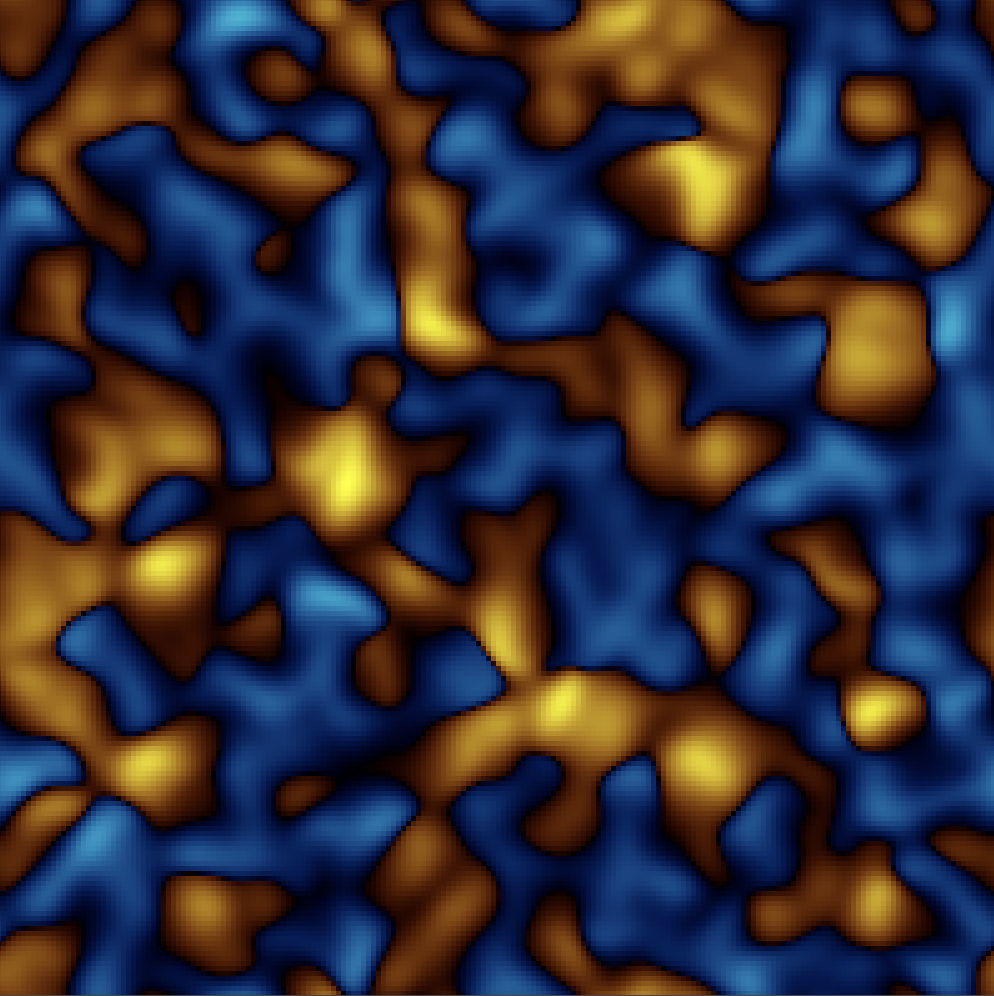
Intermixed +mass (warm) and −mass (cool) webs with concentrated nodes and large voids — the cosmic-web morphology, voids driven by negative-mass repulsion.
1. The postulate
Two ingredients only:
- ±1 charges, proton heavier. The origin makes equal numbers of +1 ("proton") and −1 ("electron"), the proton of larger (gravitational) mass; charge is present (co-aligned) only in this region. Everything else is composite.
- A two-phase electron. The electron's spatial extent adapts to the Coulomb well it occupies: compact in a deep well (inside a nucleus) and expanded in a shallow one (an atomic orbital). Temperature selects which forms.
2. Charge symmetry without baryogenesis
In this picture a neutron is p + e, so any neutral atom (A, Z) contains A protons and
A electrons: (A−Z) electrons compact inside the nucleus (one per neutron) and Z expanded in orbitals.
Protons and electrons are therefore equal in number everywhere — charge neutrality is automatic
and there is no matter–antimatter asymmetry to explain, because there is no antimatter
ingredient. The 10−&sup9; baryon-asymmetry problem of standard cosmology simply does not arise.
3. Why charge is quantized and mass is not
In one line: the large positive mass gets the + charge; the − charge is the neutrality-mandated remainder, carried by the small positive mass — that is the basic asymmetry (charge is co-seeded with mass, so charge sign tracks mass size; which sign we call + is a global labeling convention).
The construction places charge onto the mass, not independently of it. Mass sets the template — the gravitational fluctuation makes deep wells (large, concentrated mass) separated by shallow regions (small, diffuse mass) — and the electric fluctuation is co-aligned with it (one correlated primordial fluctuation sourcing both potentials, not two independent ones). The +charge then lands on the deep wells (the heavy protons), and charge neutrality forces the −charge into the shallow complement (the light electrons). The electron is thus the neutrality-mandated leftover, necessarily small and diffuse — both because the big-mass sites were already claimed by the +charge, and because, being spread out, it has large size and hence (mass ~ inverse size) small mass. The correlation big↔+, small↔− is a consequence, not a separate assumption; which sign we call + is a global labeling convention.
This is correlated seeding, not a time sequence: since electromagnetism is ~1039 times stronger than gravity, charge cannot wait for mass to finish segregating — the two must be laid down already correlated. Neutrality then keeps the newly charged scaffold bound: protons plus electron clouds carry no net long-range force, so charging does not blow the structure apart.
The same strong/weak asymmetry explains a fact usually taken as given — charge is quantized in exact units, mass is not:
| charge | mass | |
|---|---|---|
| force | strong (EM) | weak (gravity, ~1039× weaker) |
| dynamics | fast | slow |
| outcome | discrete ±1 units | continuous gradation |
| symmetry | exactly equal and opposite | grossly unequal (1836:1), top-heavy |
Fast ⇒ quantized. Strong electromagnetism drives opposite charges together fast (the Coulomb collapse of §5); stabilized by the electron's kinetic energy, they lock onto the one stable bound unit, the proton–electron pair, which carries integer charge (+1 core, −1 cloud). All charge therefore relaxes onto multiples of a single elementary unit, and +e and −e come out exactly equal and opposite because they are the same unit — quantization as fast relaxation onto the stable charged state.
Slow ⇒ gradation. Gravity is weak, slow, and — crucially — has no stable elementary unit to snap onto: same-sign mass simply keeps accreting, nothing halting it at a preferred size. Mass therefore never quantizes; it accumulates by gradation into a continuous spectrum weighted toward the big wells (most of the mass in nuclei, and upward to stars). The two 2D simulations embody the contrast directly: the charge run (fast collapse onto discrete bound ±1 pairs) versus the mass run (slow segregation into a continuous graded web).
Two honest limits remain. The fast dynamics explains why charge appears in integer multiples of a unit, but not why the unit e exists (a stable ±e soliton is still an input); and at the elementary level protons and electrons do have definite masses, so the “continuum” is really the aggregate mass spectrum — the 1836 ratio itself stays the open number of §9.
4. Two electron sizes = two energy scales
A compact electron (~fm) carries ~MeV binding; an expanded electron (~Å) carries ~eV. The same particle thus spans the nuclear and atomic energy scales — a ratio of ~105–106. This is the unification the program reaches for:
| bound by | example | scale | |
|---|---|---|---|
| molecule | expanded (valence) electrons gluing nuclei | H&sub2; = 2p + 2 big e | Å / eV |
| nucleus | compact electrons gluing protons | He-4 = 4p + 2 small e | fm / MeV |
Chemistry and nuclear physics become one Coulomb free-boundary mechanism at two scales, differing only in the electron's phase. (What physically sets the separation is the central open problem — see §9.)
Why the gap is α². The electron has three characteristic lengths — the three ways to build a length from (ℏ, m, c, e), each differing by one factor of the fine-structure constant α=e²/ℏc:
a0 = ℏ²/me² ≈ 0.5 Å (atomic) ⟶×α
λ̅C = ℏ/mc ≈ 386 fm (Compton) ⟶×α
re = e²/mc² ≈ 2.8 fm (classical / nuclear)
a0 : λ̅C : re = 1 : α : α²
The model has two electron phases — expanded (atomic, a0: ℏ,e, non-relativistic Coulomb) and compact (nuclear, re: e,c, electromagnetic mass). The middle length, the Compton wavelength (ℏ,c, the quantum-relativistic scale where confinement costs ~mc²), is the quantum rung between them — which is why the nuclear/atomic gap is α² (two steps of α), not α. Dropping ℏ carries you from the atomic to the classical scale; α is the price of each step. (The value of α itself is an input — §9.)
The two sizes, set by charge and proton size — without mass. Described by charge and a kinetic coefficient κ alone (the electrostatic structure needs no mass), the same electron takes two forms:
- Outside (atomic): attracted to one proton, its density must taper to zero in vacuum; a varying profile carries kinetic energy κ/L², which forces a large cloud — size set by the proton's charge, L = a0.
- Inside (nuclear): caged by protons with a multiphase free boundary — its density does not drop to zero, it hands off to the proton density. A flat caged density then has ∇ψ = 0 throughout, hence zero kinetic energy: there is no kinetic penalty for being small. Its size is set by the proton's finite size (the cage floor that stops collapse), and its binding is Coulomb at that size (~MeV at fm).
So the crucial factor is proton charge vs proton size: charge fixes the outside electron (a0), the proton size fixes the inside cage (Rp), and the ratio is Loutside/Linside = a0/Rp ≈ 1/α² (since Rp ≈ the classical radius ≈ a few fm). The nuclear scale thus follows from Coulomb plus the proton's finite size, via a zero-kinetic-energy flat caged electron — no relativistic effect required. (The kinetic "obstacle" κ/L² applies only to a vacuum electron forced to taper to zero, not to a caged one whose density stays finite at the free boundary.) Mass plays no part: it is a separate, gravitational quantity — the matter-wave's inverse size (Compton wavelength / dispersion gap) — while the atom and nucleus are built from charge and κ alone.
Inputs of the electrostatic model. The whole atom/nucleus structure needs just three: (i) the charge / Coulomb potential e², (ii) the electron kinetic coefficient κ, and (iii) the proton's finite size Rp. From them: the atomic scale a0 = 2κ/e² (from κ, e²) and the nuclear scale Rp with binding ~e²/Rp (from Rp, e²). No mass, no c, no strong force, and α is not fundamental. Mass (inertia) and gravity are a separate sector, coupling in only through energy (E = mc²).
What α signifies. The fine-structure constant then emerges as a pure geometric ratio of the two scales: α² = Rp/a0 = (proton size)/(atomic size), α = √(Rp/a0) — how much smaller the nucleus is than the atom. Not a coupling constant, and no c required. It equals the textbook α = e²/ℏc only because the proton sits at the classical-radius scale (Rp ≈ α²a0 ≈ a few fm). So the model reframes “why α ≈ 1/137” as “why is the proton ~fm while the atom is ~Å” — relocating the question to the proton size (an input), and interpreting α itself as the proton-to-atom size ratio.
Empirical check. Observed sizes: the H atom ≈ a0 = 0.53 Å ≈ 53,000 fm; the deuteron nucleus ≈ 2.1 fm (rms). Their ratio ≈ 4×10⁻⁵ ≈ 1/25,000 — matching α² ≈ 5×10⁻⁵ ≈ 1/18,800 to within ~30%, with the deuteron (~2.1 fm) sitting essentially at the classical electron radius (re = α²a0 = 2.8 fm). So the α² nuclear/atomic size relation is confirmed to order of magnitude — the H-atom/deuteron-nucleus size ratio comes out as 1/α², from charge, ℏ and c alone, with no strong force. (The deuteron is unusually loosely bound, so read this as the scale/ratio being right, not a precise fit.)
5. Temperature and the cosmic sequence
A bound state survives once the bath can no longer ionize it (kT < binding). The two phases therefore switch on at two temperatures set by their two binding energies, giving a forced order:
| epoch | process | temperature | time |
|---|---|---|---|
| plasma | free ± charges | > 1010 K | < 1 s |
| nuclear condensation | compact e captured → nuclei (p-e-p, α, …) | ~1010 K (kT~MeV) | s–min |
| atom formation | expanded e captured → atoms; releases radiation | ~3000 K (kT~eV) | ~380 000 yr |
The temperature ratio between the two epochs (~106) is the same number as the energy-scale ratio — one fact, not two. The nuclear electrons freeze in first (deeply bound, never released on cooling); the atomic electrons join far later. This reproduces the standard cosmic order (nucleosynthesis, then atom formation) from a single cooling curve.
6. The neutron, and the weak interaction as a size-transition
The compact electron is precisely the electron inside a neutron: neutron = proton + compact
electron (the pre-1932 model). The two weak processes then become the two directions of the
size-transition, driven by temperature/density:
- compactify (expanded → compact):
p + e → n— electron capture; - expand (compact → expanded):
n → p + e— β-decay.
This lands on real astrophysics: crushing matter (high density/T) forces electrons compact → wholesale p→n → a neutron star (neutronization in core collapse). The cosmic neutron/proton ratio at freeze-out is the compact/free electron ratio at the transition temperature.
7. The quantitative handle: T\* and the helium fraction
The postulate makes a sharp prediction: there is a transition temperature T\* at the compactification energy. The fraction of electrons that compactify by freeze-out fixes the cosmic neutron/proton ratio, and hence the primordial helium fraction. Matching the observed ~25% He (n/p ≈ 1/7) is the decisive quantitative test. In standard physics freeze-out is at kT ≈ 0.8 MeV (T ≈ 1010 K), tied to the n–p mass difference 1.29 MeV — so the prediction is T\* ≈ ~MeV ≈ ~1010 K. Equivalently, the universe's small:big electron ratio = N:Z of primordial matter ≈ 1:7, dominated by plain hydrogen (no compact electron).
The calculation. A neutron is a proton with a compact electron, so the neutron/proton ratio is the compact/free electron ratio at freeze-out, (n/p)f = exp(−E*/kTf), with the compactification gap E* playing the role of the n–p mass difference. Free neutrons partly expand back (β-decay, factor d) before nucleosynthesis, and essentially all survivors end in He-4: Y = 2(n/p)nuc/(1+(n/p)nuc). With the model's single MeV-scale handle — E* ≈ 1.29 MeV, Tf ≈ 0.8 MeV (T* ∼ 1010 K), d ≈ 0.74 — this gives (n/p)f = 0.199 → (n/p)nuc = 0.140 → Y = 0.245, the observed primordial helium. So one MeV-scale compactification energy reproduces the ~25% helium — the model's first falsifiable quantitative success. (Honest caveat: Tf is, in standard BBN, derived from weak-rate vs. expansion; here it is a second input, so the genuine prediction is the ratio E*/kTf ≈ 1.6 with E* ∼ 1.3 MeV.) — interactive calculator.
8. Energetics: where the binding energy goes — and what drives formation
Forming a deuteron releases its binding (~MeV). Because the binding here is Coulombic (an electron dropping from the expanded into the compact phase), the energy is released exactly as an atomic electron releases energy falling to a lower level — by emitting photons, just scaled up ~105 to ~MeV gammas. Three equivalent readings:
- radiation — ~MeV photons into the plasma (standard physics agrees: p + n → D + γ, 2.224 MeV);
- mass defect — the deuteron is lighter than its constituents by binding/c²; the radiated energy is the missing rest mass (E=mc²);
- heat — recoil kinetic energy re-absorbed by the surrounding plasma.
Cosmological fate. This occurs at ~1010 K into a bath with ~109 photons per baryon, so the few MeV per baryon is a ~10−8 perturbation — absorbed into the photon background and then redshifted to insignificance by expansion. The universe is not noticeably reheated; the energy simply joins the radiation reservoir and cools with everything else.
Is the formation self-sustaining? No — it is cooling-driven
The released gammas feed the same bath that can re-dissociate a fresh deuteron while kT ≳ binding, so at high T the energy release brakes the process. Net formation proceeds only as the universe cools below T\* — the deuterium bottleneck. This is the opposite of stellar fusion: that is Coulomb-barrier-limited (favored by heating, energy release sustains the high T it needs → runaway), whereas deuteron formation is exothermic capture (favored by cooling) → it self-quenches at high T and switches on as the universe cools.
Is density the key? For yields, yes; for ignition, no
A hot (ionized) start is required so bound states can form on cooling. Proton density sets the yields — how much D/He forms and at what temperature — exactly as the baryon density η fixes the BBN abundances; it is not an ignition switch. The one genuinely self-sustaining channel is gravitational: in a collapsing dense region (the ±mass Poisson source of this cosmology), rising density forces electrons compact (p + e → n) in a runaway sustained by gravity, not by the photon energy — i.e. neutron-star neutronization. The smooth cosmic background is cooling-driven; dense collapsed regions are gravity-driven.
9. Open problems (load-bearing)
| problem | what it demands |
|---|---|
| The nuclear scale | What sets the ~104–105 nuclear/atomic separation? Candidate (preferred): take the proton's finite size Rp (~fm) as the input nuclear length. An electron caged by protons with a multiphase free boundary (density finite, not dropping to zero) can be flat ⇒ zero kinetic energy, so it sits at the cage (proton) size with no kinetic penalty; binding is Coulomb (~MeV at fm). The size ratio to the atomic (charge-set) electron is a0/Rp ≈ 1/α² — no relativity needed. Alternative: the relativistic classical radius r = α²a0 ≈ 2.8 fm (Coulomb self-energy = rest energy, in the sense of Many-Minds Relativity), giving the same ratio 1/α². open which primitive (proton size vs relativistic), and whether the solver realizes the flat zero-KE cage — direct runs so far were inconclusive (non-convergence at small cage size). The kinetic "obstacle" κ/L² applies only to a vacuum electron, not a caged one. |
| The fluctuation spectrum & φ dynamics | ρ = ∇²φ gives a blue (k²-amplified) density spectrum, but large-scale structure fits a near scale-invariant one (ns ≈ 0.96) — so the potential φ must carry a compensating red spectrum. And ρ=∇²φ is a definition, not yet a law of motion: φ needs its own field equation. to be derived and checked against structure data. |
| The mass ratio mp/me=1836 | The origin's mass-split makes the proton heavier than the electron (gravitationally), so the mass difference is now built in — but its value (1836) is not derived (nor is it in the Standard Model: proton mass ~99% QCD binding, electron mass from the Higgs). A subtlety to reconcile: the quantitative nuclear binding (He-4/deuteron 13.1 vs 12.7) treats protons as charge clouds with an electron-like kinetic coefficient, so the gravitational mass (heavier proton) is distinct from the electrostatic kinetic coefficient κ (both charge clouds). value unsolved; gravitational-vs-electrostatic mass to be reconciled. Numerological aside mp/me ≈ 6π5 = 1836.1. |
| The neutrino | β-decay has a continuous spectrum — the 1930 objection that sank the p-e neutron and forced Pauli's neutrino. The "electron expands" needs a home for that energy & spin. open. |
| Precision data | BBN abundances (75/25 H/He, D, Li) are percent-level triumphs the sequence must reproduce, not just qualitatively. to be tested. |
| Antimatter, proton substructure | Positrons/antiprotons exist; the proton has quark structure. A two-ingredient ontology must say what these are. open. |
10. Computational status (RealQM)
What the engine has actually shown, versus what remains:
- ✓ Done. p-e-p binds as a stable configuration; the He-4/deuteron binding ratio comes out 13.1 vs experiment 12.7. The p–lepton–p scaling wall shows the size law R ∝ 1/mglue (electron→atomic, muon→512 fm), with muon-catalyzed fusion as the observed proof that a heavy negative glue binds two protons. The n/p–vs–T helium calculation (§7): a single MeV-scale compactification energy gives Y = 0.245 — the observed primordial helium (interactive calculator).
- ☐ Open. The two-scale test (does one engine give MeV and eV in the same units?) — equal-mass Coulomb returns ~1, confirming a scale ingredient is needed. A cooling-quench (using RealQM's temperature / Brownian-dynamics machinery) that enacts the two condensation epochs.
11. Complexity from the proton–electron size asymmetry
The world is built not on a charge imbalance (charge is exactly balanced, ±e) but on a size imbalance: the proton has a fixed, small size (a rigid anchor) while the electron's size is variable — it adapts to its well, spreading to ~Å in an atom and compacting to ~fm in a cage. The fixed proton supplies the anchors; the variable electron spans scales — spreading to bind atoms and molecules, compacting to bind nuclei — producing the nested multi-scale hierarchy that is complexity. With a fixed size for both, only one scale exists and nothing complex is built (both small → only nuclei; both large → only atoms). And α measures exactly this asymmetry: α² = Rp/a0 is the inverse dynamic range of the electron — a factor 1/α² ≈ 18,800 between its nuclear and atomic phases — so the smallness of α is the engine of complexity. Equal fixed sizes would build nothing.
References
- [MMR] C. Johnson, Many-Minds Relativity — special relativity as medium/aether physics: c as the wave speed of a real light-carrying medium, mass as field self-energy, P=mc ⇒ E=mc² (ch. 16), Galilean kinematics, and a critique of Einstein's special relativity as "empty of real physics."
- A. D. Sakharov, Vacuum quantum fluctuations in curved space and the theory of gravitation (1967) — gravity as the elasticity of the vacuum (induced gravity).
- C. Johnson, RealQM and RealNucleus — multiphase Coulomb continuum mechanics; interactive gallery.